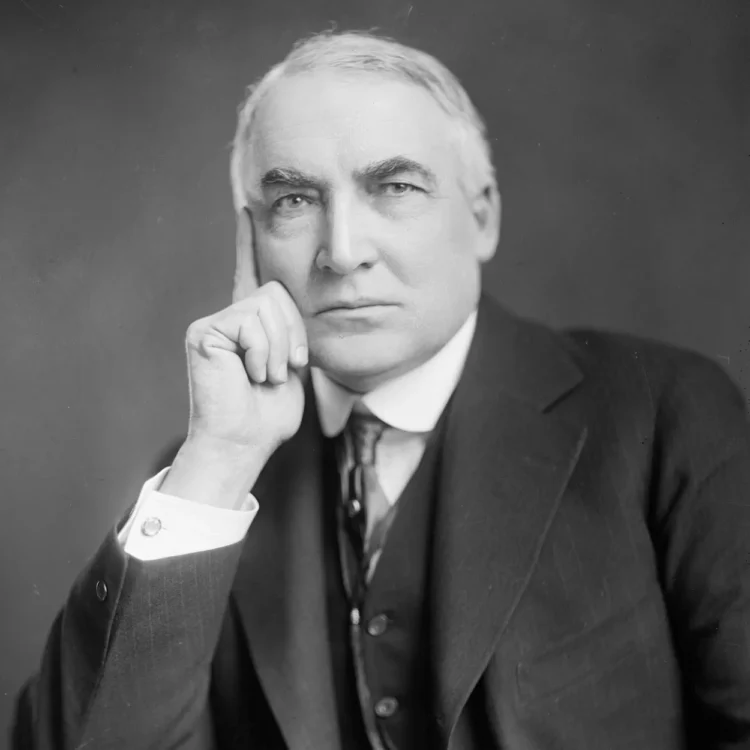
When Donald Trump contracted COVID-19 in 2020, Warren Harding was briefly back in the news as one of the four US Presidents to die of natural causes in office. Despite a landslide election and great popularity in his day, Harding had slipped from public memory until Malcolm Gladwell put him in Chapter 3 of his book Blink.
Gladwell uses ‘the Warren Harding error’ as a cautionary tale: an illustration of how snap judgements can go badly wrong, why choosing the right candidate is so hard, and why, more often than we care to admit, hiring fails to deliver.
Blink is a book about how we ‘know’ something without quite knowing why. It is about the power of first impressions, and it argues that a decision made in an instant can be every bit as good as one made slowly and deliberately.
Many interviewers would take that as good news. It is common for less experienced interviewers to make their decision in the first few minutes of the interview, and many of us pride ourselves on using intuition and gut feel to spot a high-potential candidate. We have all sat across the table from someone who simply looked the part, and felt the pull to say yes.
Harding is the warning. He was the 29th President of the United States, from 1921 until his death in 1923. Several scandals surfaced after he died, along with an extramarital affair that did little for his reputation. His chief asset, it seems, was that he ‘was worth looking at’. He was ‘handsome, with an impression of physical grace and virility’; his voice was ‘noticeably resonant, masculine and warm’; his manner suggested ‘a generous good nature and a sincere kindliness of heart’. He was not an especially intelligent man, but he ‘looked like a senator’, and radiated dignity and everything that seemed presidential.
As Gladwell puts it, many people who looked at Harding ‘saw how extraordinarily handsome and distinguished-looking he was and jumped to the immediate, and unwarranted, conclusion that he was a man of courage and intelligence and integrity’. He was not. Historians now rate him among the worst presidents in American history.
Gladwell describes the Warren Harding error as the dark side of rapid cognition, and the root of a good deal of prejudice and discrimination. His point is that snap judgements work well only when they are made by genuine experts within their own field. In the interview room, where few of us are experts at reading character on sight, that same speed leaves us exposed to subconscious bias, both positive and negative, and that is where hiring failure begins. It is also one reason a shortlist needs more than one diverse candidate: bias rarely announces itself.
In Asset Management, where a senior hire may be assessed over only a round or two of interviews, the cost of the error is high. A poor appointment can take years, and a good deal of money, to unwind.
This is why we built our Best-Fit Search™ process. We first identify candidates against Quantifiable Criteria, agreed with the client and applied equally to everyone on the list, and then run a three-step Best-Fit Assessment to gauge fit for the role. Subjecting every candidate to the same structured scrutiny is what takes the Warren Harding error out of the process, and it is one reason 79% of the people we have placed since 2013 are still with the same firm.
If you would like to discuss how a structured assessment process could keep first impressions, and the biases that travel with them, from driving your next senior hire, please contact us at hello@godliman.com.