
- Advice for Hiring Companies
Why a shortlist needs more than one woman
Include at least one woman on shortlist of candidates
- September 5, 2024

As the Pandemic receded and we started returning to work, the ‘Culture’ of a company has become foremost in employees’ minds. Having worked at home, in a less pressurised, more informal environment, and spending more time with family, employees are now as concerned with the work environment, team dynamic, and company values, if not more, as they are with career progression and salary when it comes to moving job.
The ‘Culture’ of a firm was already a key driver for organisations that had identified that values-based company cultures lead to higher employee satisfaction and therefore better performance and productivity. Given today’s concerns about mental health, in simple terms, it leads to a happier workforce!
The Financial Services industry in London and the Professional Services firms around them proliferated from 1980 onwards, on the back of a rising bull market, with London seen as one of the three main financial global centres. Businesses expanded quickly, often following the example of Investment Banks: senior ‘rainmakers’ at the top brought in business. They were paid accordingly, while juniors carried out the hard graft and were paid significantly less. Culturally, these firms were hierarchical which led to a territorial attitude over clients and in-fighting over staff bonuses. Overall, a ‘dog eat dog’ culture pervaded which made for divisive team interaction and demoralised junior staff.
This ‘Hunter’ culture is still prevalent in many Banks, Asset Managers, Insurers, Lawyers, Recruitment firms, etc.
However, some firms wished to buck this trend. When Godliman was founded 20 years ago, we wished to return to a values-based model, identifying with the notion of ‘One-Firm’ firms, as described in David Maister’s book: ‘Managing the Professional Service Firm’.
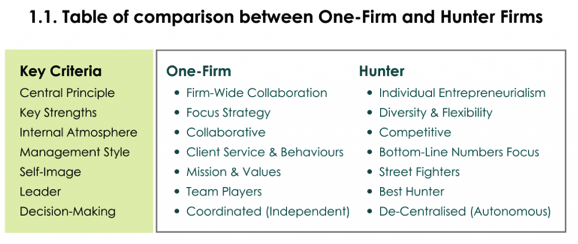
We should stress that there is no right or wrong here: both Hunter and ‘One-Firm’ firms can achieve great commercial success, and often it boils down to an emotional choice as to which type of culture ‘feels right’ to individuals. And there is, of course, a spectrum of cultures in between these two poles, with many firms combining some elements of both types.In the Asset Management sector, we have found that many Institutional Asset Managers tend to be more ‘One-firm’ in culture, whereas Retail and Alternatives/Hedge Funds tend to be more Hunter.
Because of their focus on firm-wide collaboration ‘One-Firm’ firms are often described as ‘nicer’ places to work, and employees tend to feel ‘lucky’ that they work there. So, one would assume that these firms can take their pick of the best employees when it comes to hiring.
Unfortunately, however, that is not the case. They often find senior hiring difficult.
We have found that hiring processes for ‘One-firm’ firms tend to take much longer and are less decisive than for Hunter firms. The problem lies in the ‘One-firm’ firm’s self-belief. This strength of feeling can also be its weakness, and can lead to the following common issues:
The net effect is often delay and indecision, and the concern about possible disruption, which can all lead to the ‘least offensive’ candidate being hired, often losing the best, most dynamic candidates. The slow and one-sided hiring process can also damage their market reputation as disgruntled candidates spread the word.
So, what is the answer?
It is often hard to point these issues out to clients who are rightfully proud of their strong culture. They often do not like to hear that they are potentially negatively impacting the recruitment process. They want to preserve the culture, so why should they change?
Still, we feel there are some simple tips for those ‘One-firm’ firms that would make hiring more effective, including:
So yes, ‘One-firm’ firms are the most team-oriented and therefore are very content workplaces, but they need to take care to ensure that they maximise their effectiveness when recruiting.

Include at least one woman on shortlist of candidates

With recent focus on cost-cutting many Asset Managers choose to do their own recruitment – but this can risk an over-reliance on interviews.