Across Asset Management, more clients are asking us to put women on the shortlist. Yet the numbers have barely moved in a decade. Hiring more women is less a matter of intent than of process, and most firms have not yet changed the process.
Rising client demand for diversity is a challenge across an industry that, outside ESG, remains dominated by men, in both investing and distribution. The charts below, drawn from our EMEA Buy Side Sales benchmark (the UK Sales Universe of c.2,600 people, as at September 2023), show the gender split by channel. The problem worsens with seniority: the more senior the role, the fewer the women.
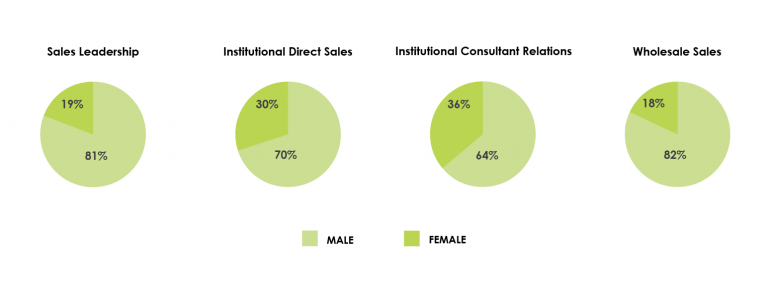
Despite years of acknowledging the challenge, little has changed. Over the five years to 2023, the hiring of women salespeople in the UK exceeded the standing benchmark by an average of just one percentage point. The picture on the Continent is no better, with the exception of France, which leads EMEA on gender diversity.
Part of the explanation is our tendency to favour people like ourselves when hiring. With more men in decision-making roles, that inclination quietly works against women. It is known as the ‘homophily effect’, the tendency to associate with people similar to ourselves, documented by sociologists McPherson, Smith-Lovin and Cook in their 2001 review Birds of a Feather. It is also one of the forces behind the authority gap women face at work.
Demand for women is high and the candidate pool is small, so hiring firms, search firms and clients alike, have to work harder and think more carefully about how they run the process. So what can be done to bring female talent onto the shortlist, keep them engaged, and let them show their capabilities without favouring one gender over the other?
- Build longer-term relationships with women in the industry. Engage with candidates long before a suitable role exists. A consultative, slow-burn conversation, understanding what kind of role would appeal before approaching about a specific one, tends to work better. This partly reflects the more relationship-led approach many women take, which several studies have also linked to a more risk-aware investment style.
- Be clear why you want gender diversity. Decide what value you expect women to bring to the team, and gear your requirements and assessment to it. One report found that women hedge fund managers had outperformed men, attributing it to a greater readiness to seek out other views, to encourage people to speak up, and to take longer over decisions (Forbes, July 2021).
- Focus on individual motivation. Candidates of either gender weigh what makes a role attractive differently. Beyond money or a promotion, lifestyle and personal priorities often sit higher on the list than financial gain or management responsibility. Understand those motivations and address them early.
- Introduce a woman interviewer early in the process. This makes a female candidate more comfortable and signals that the firm values senior women. Someone who can guide the candidate through the process may also improve the odds of an offer and lay the ground for a longer relationship once she joins.
- Watch the language. Job specifications and interview conversations carry words that can leave women less interested, or implying the role is not for them, such as highly competitive, ambitious, confident or tough. Choose them with care.
- Think about the composition of the interview panel. If you ask candidates to present or take part in a panel discussion, consider its gender makeup. Is it as easy for a woman to present to a room of men as it is for a man, when the sense of ‘these people are like me’ is not as immediate? And will a panel drawn from similar backgrounds assess objectively?
- Ensure pay parity. Pay gaps persist, for many reasons (a topic for another article). It falls to Executive Search firms and clients alike to make sure the pay is fair for the role and the experience, regardless of gender. Put bluntly: a woman should be paid what a man would be paid for the same role with the same capability, not an uplift on her current package, which only perpetuates the gap. Pay the market rate. In some US states it is now unlawful to ask candidates their current pay, for exactly this reason.
Hiring the right person on skill and cultural fit is hard enough; doing it while widening the pool of women is harder still, given how few are in the market to start with. None of the steps above is complicated, but together they require a process built for the purpose rather than goodwill alone. The ‘Godliman Rule’ commits our clients to interviewing at least two diversity candidates on every shortlist, because a list with only one woman rarely ends in her appointment.
If you would like to discuss how to bring more women onto your shortlists, and assess them fairly once they are there, please contact us at hello@godliman.com.